Tiffany N. Florvil, Ph.D.
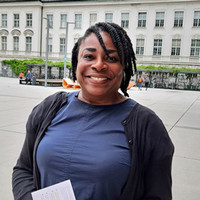
Tiffany N. Florvil is an award-winning Associate Professor of 20th-century European Women’s and Gender History at the University of New Mexico, Albuquerque. She specializes in the histories of post-1945 Europe, Black Europe/Black Germany, the African/Black diaspora, Black internationalism, human rights, as well as queer and gender studies. She has published in Signs, The German Quarterly, and other journals.
Florvil has also coedited the volume, Rethinking Black German Studies: Approaches, Interventions and Histories (2022 paperback, 2018 hardback) and published Mobilizing Black Germany: Afro-German Women and the Making of a Transnational Movement (University of Illinois Press 2020) and its German translation, Black Germany-Schwarz, deutsch, feministisch-die Geschichte einer Bewegung (Ch. Links Verlag 2023). Her 2020 book won the Waterloo Centre for German Studies First Book Prize in 2021, among other honors.
She has given talks across the United States, Europe, and Canada.
She is the co-founder and series editor along with Kennetta Hammon Perry and Olivette Otele of “Histories of Black Europe,” a new book series with Cambridge University Press (CUP). She is finalizing a volume entitled “Innovations in Black European Studies” currently under contract with Peter Lang Press. In the spring and summer of 2023, Florvil was the Anna-Maria Kellen Fellow at the American Academy in Berlin. In 2023-24, she was the Joy Foundation Fellow at Harvard University’s Radcliffe Institute for Advanced Study, where she worked on a biography of prominent Black German poet May Ayim.
Why Africana Studies?
The real question is why not Africana Studies?
Africana Studies has long been the site for rigor, bricolage, critical inquiry, political urgency, and resistance not only in the United States but across the African/Black diaspora.
From C.L.R. James to June Jordan and from George Padmore to Claudia Jones, Africana Studies has continued to offer scholars’ and activist-intellectuals’ opportunities to be, to theorize, to innovate, to evolve, to challenge, and to survive the hold of white supremacy.
Its more formal institutionalization in the late 1960s was built upon the work of activists and feminists who saw its merit in confronting racist epistemologies, ontologies, and impositions that sought to suppress and ignore the contributions of people of African descent.
It is this rich legacy that has shaped my own work in Black European Studies.
More importantly, Africana Studies is the physical manifestation of “a ‘space of radical openness’ and creativity, where new critical discourses take place” (bell hooks).